Think about all the decisions we make on a daily basis. The outfit we pick out, the lunch we pack for the day, the show we watch after school the list goes on.
Have you ever thought about how any of these decisions are made? Probably not.
That’s where journey maps come in.
What are journey maps?
Nielsen Norman Group defines journey maps as “a visualization of the process that a person goes through in order to accomplish a goal.
Journey maps help people understand each step that goes into making a decision, laying out every single action that takes place within a step of the decision process.
This is a very detailed process, but it helps stakeholders understand what goes through a user’s mind when making a decision, no matter how big or small. It might seem like a lot of work, but it’s extremely beneficial in understanding users and creating experiences that users would enjoy.
Creating a journey map
To fully understand how a journey map works, I created one for an everyday task.
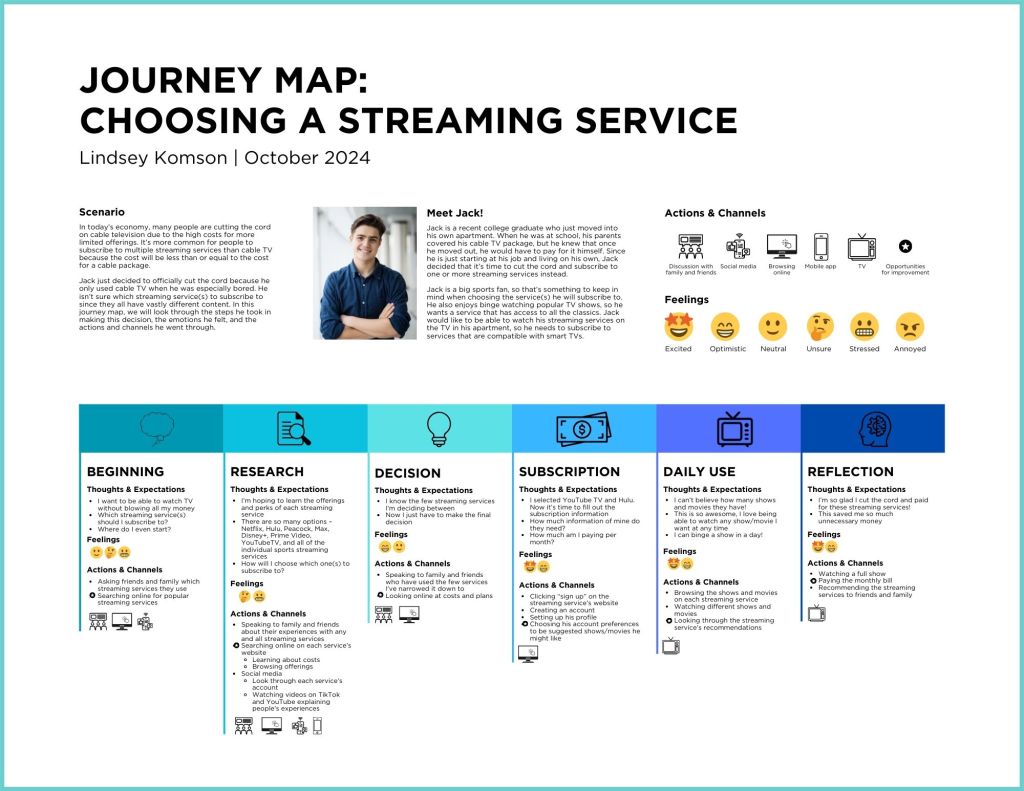
First, I chose a process, created a persona, and defined a goal. For this exercise, I picked the process of choosing a streaming service to subscribe to. The goal for my persona, Jack, was to choose one or two streaming services to subscribe to.
Next, I developed Jack’s background. Jack is a recent college graduate who is moving into a new apartment to start his first job. When he was in college, his parents paid for his cable TV package, but now that he’s living on his own, he needs to pay for his own entertainment. He decided to cut the cord since streaming is less expensive than the cable package he previously had, and has to choose which streaming services benefit him the most. Jack has a smart TV, so a big factor for him in this decision is that the streaming service he chooses connects to his smart TV.
I broke down the process from the beginning to Jack’s reflection into 6 steps: Beginning, Research, Decision, Subscription, Daily Use, and Reflection.
The first step is the beginning, where Jack realizes he wants to cut the cord and mve to streaming services. Then, he conducts research, asking family and friends about their experiences and scrolling social media to learn about others’ perspectives. Jack must make a decision after that, recognizing all the research he’s done and experiences he’s heard. From there, he goes online to the streaming services’ websites, puts in his billing information, and officially subscribes to one or more streaming service. Once he’s subscribed, he uses each service daily and enjoys the endless content he has at his fingertips. Lastly, he reflects on his purchase decision and enjoys the vast selection of media he has access to.
Journey maps are not only helpful in understanding each step of the process, but the way the user feels at each stage. We always want a happy user during any experience we create for them, so this map helps showcase where a user might feel negatively and how we can change that.
It’s clear that journey maps are an essential part of the user experience design process, and I recommend creating one yourself, even if it’s just for practice like mine! View my journey map below:
 Lindsey Komson
Leave a comment